Case study: a Belarusian birth certificate after an RFE
A client received a Request for Evidence (RFE) from USCIS and needed a new Belarusian birth certificate translation. The certificate was issued in Soviet times, on a bilingual form. The old translation was not really a translation but a loose summary, with errors in the date and the certificate series. We translated the certificate again, in full, the same day, and the next day made a second version on request: a translation in the original layout.
Why the client came to us
The client wrote to us on WhatsApp: USCIS had sent a Request for Evidence (RFE), and a new translation of the birth certificate was needed. It is a Soviet Belarusian birth certificate. The form is bilingual: every field is labeled in Russian and in Belarusian, and the entries are handwritten. On top of the fields there is a Belarusian stamp recording that a passport was issued.
What was wrong with the old translation
The client sent the old translation made by another translator. It was not really a translation but a loose summary: a few “label — value” lines instead of the form. USCIS asks for a full translation (8 CFR 103.2(b)(3) (opens in a new tab)), and a summary does not qualify (USCIS Policy Manual (opens in a new tab)). What it left out:
- the empty fields — district, region, republic: they are simply missing, so you can’t see they are blank on the form;
- the Belarusian text: half of the form is in Belarusian, and the translation doesn’t mention it;
- the stamp: the Belarusian passport stamp turned into a line “Passport…”, with nothing to say it is a stamp;
- descriptions of the seal and the signature: just the words “Seal” and “Signature”.
And the errors:
- the wrong year in the date of issue;
- the characters of the certificate series mixed up;
- “BSSR” added to the place of birth, although the “republic” field on the form is empty.
Each of these can prompt another question from the agency: the translation says something the document doesn’t.
How we translated it
- In full, from the original. Every field in the order of the form, the empty ones too: an empty field is marked [blank], not left out.
- Both languages of the form. The Russian field labels are translated into English; the Belarusian ones are reproduced next to them with the note [Text in Belarusian]. Each field stays one line with one value, even though it has two labels. This shows nothing in the document was left out.
- Stamp and seal. The Belarusian passport stamp is reproduced as it appears on the original, with a note on its language. The round seal of the civil registry office can’t be read, so the translation marks it [Round seal, illegible] instead of guessing.
- Names. The client confirmed that the names in the old translation were spelled right, and we kept that spelling so it matches the other documents in the case.
- Dates and numbers are checked against the original character by character.
The client got the standard translation the same day, a few hours after payment.
A translation in the original layout
The client asked for one more version: a translation that looks like the form itself — both halves of the form on one page, the child on the left, the parents on the right, each entry on the same line as on the form, the small print under the lines, and the seal and the stamp where they are on the original. We made it the next day. USCIS rules don’t require a translation to copy the look of the form: they ask for a complete and accurate translation with the translator’s certificate. We make a translation in the original layout on request, when it is more convenient for the client or their attorney.
The same form, translated both ways
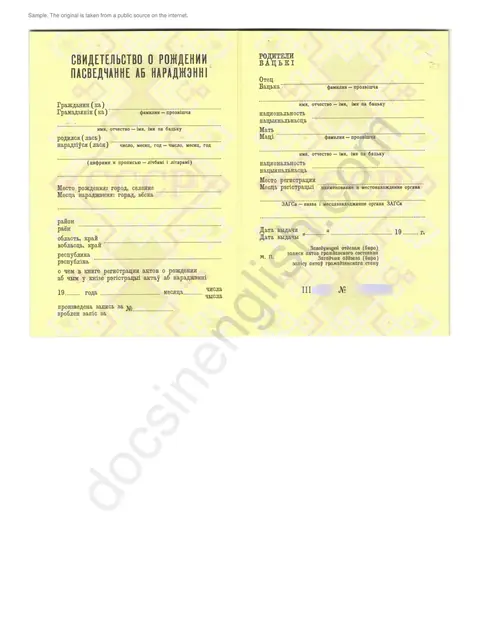
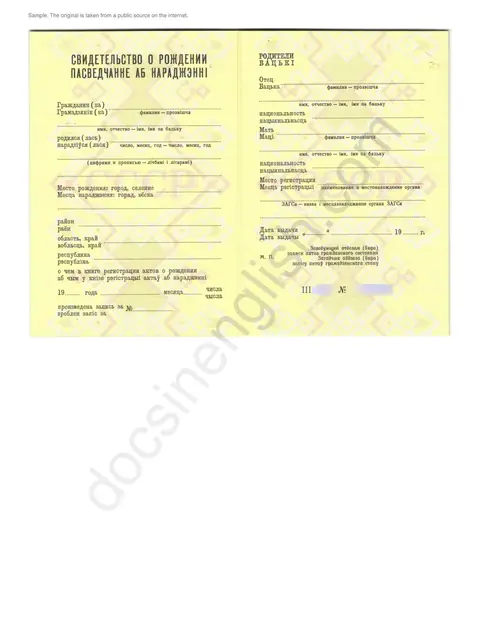
We don’t show the client’s document. Below is a real blank Soviet Belarusian birth certificate of the same type (1971–1997) from a public source, translated both ways: the standard translation and the one in the original layout. The fields are empty, so the translation says [blank].
What to file in your case is for you or your attorney to decide.
Sample translations
2 samplesEach sample has the original, the translation and the signed certificate. Personal details are blurred.
Questions
How much does a birth certificate translation cost?
A birth certificate is usually one page: $25. A translation in the original layout is $65 a document.
Can you fix someone else’s translation?
Only if it is complete and usable: then we review it and certify it (see the price list). A loose summary like this one can’t be fixed, so we translated the document again from the original. The old translation still helped: the names in it were already in the case, and we kept their spelling.
How long does it take?
1–4 documents: within 24 hours after payment; faster, within 12 hours (+$15 a page) or 3 hours (+$30 a page, paid between 8 am and 6 pm Pacific time). For 5 or more, we give you the date with the quote.
Will USCIS accept the translation?
No one can promise that an agency will accept a document. We follow its rules to the letter, and if an agency raises an issue with our translation, we fix it for free.
How we do it
- Full translation
every stamp, signature and handwritten line
- Signed certificate
with the translator’s name, address and phone
- A PDF, ready to file
original, translation and certificate, translation pages numbered
- Price
$25 for the first page up to 250 words, $20 for each additional page, in the same document or another one.
- Turnaround
1–4 documents: within 24 hours after payment; faster, within 12 hours (+$15 a page) or 3 hours (+$30 a page, paid between 8 am and 6 pm Pacific time). For 5 or more, we give you the date with the quote.
This is a summary of what the agency publishes, not legal advice.