How do you translate a police certificate from El Salvador (solvencia de la PNC) for a US immigrant visa?
For an immigrant visa, the US Embassy in San Salvador asks every applicant aged 18 or older for the police certificate from El Salvador called Solvencia de la Policía Nacional Civil. USCIS and the immigration court ask for a full English translation with the translator’s signed certification. We translate the solvencia in full: the photo described in brackets, every field, the chief’s signature and the QR code of an online copy. It is usually one page: $25, ready within 24 hours after payment.
The solvencia de la PNC
The US Embassy in San Salvador asks all immigrant visa applicants aged 18 and older for the police certificate named Solvencia de la Policía Nacional Civil. A new one goes into CEAC if your case is electronic (U.S. Embassy San Salvador (opens in a new tab)).
The solvencia comes from the certifications department (Departamento de Solvencias) of the National Civil Police and costs $3.50. It has your photo and the signature of the department’s chief; a copy issued online has a QR code to check it. You can request it at simple.sv, or in person with your original DUI and a photocopy if you are 18 or older. The embassy doesn’t accept certified copies of it (U.S. Department of State (opens in a new tab)). On simple.sv the service is listed as constancia de antecedentes policiales, run by the PNC’s police records unit (simple.sv (opens in a new tab)).
Antecedentes penales and court records
The constancia or certificado de antecedentes penales is a different paper: the State Department lists it as a prison record from the General Directorate of Prisons (Dirección General de Centros Penales). It costs $3.00, Salvadoran citizens can request it online at simple.sv from any country, and offices in San Salvador, San Miguel and Santa Ana issue it in person.
The PNC’s certifications department doesn’t give individuals their criminal history. A visa applicant with an earlier arrest in El Salvador gets the arrest and court records from the police station where they were held or the court where the trial took place. For an arrest that never went to trial, the Attorney General’s Office (Fiscalía General de la República) issues a record with the prosecutor’s resolution (travel.state.gov (opens in a new tab)).
What the translation includes
We translate each record in full (8 CFR 103.2(b)(3) (opens in a new tab)): the heading, every field with its answer, the photo, seals and signatures described in square brackets, and the QR code with any verification number next to it. Names follow your passport; tell us the spelling when you order.
Where the translation goes
- NVC and US consulates: the Department of State doesn’t ask for a translation of a certificate in Spanish if you are applying for your visa in El Salvador or another country where Spanish is an official language. What NVC accepts
- USCIS: the Form I-485 instructions ask for certified police and court records of any criminal charges, arrests or convictions, including outside the United States (Form I-485 instructions (opens in a new tab)). What USCIS accepts
- Immigration court: a typed certification with the translator’s address and phone. What the court accepts
Our Spanish documents are translated and certified by a native Spanish speaker. What to file in your case is for you or your attorney to decide.
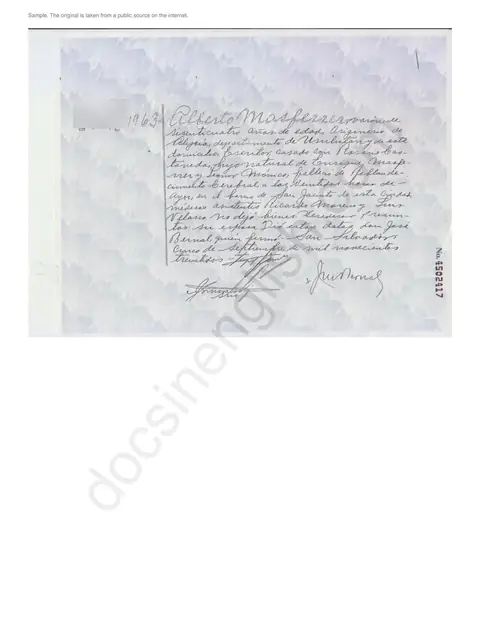
Sample translation
The sample has the original, the translation and the signed certificate. Personal details are blurred.
Questions
I was arrested once in El Salvador. Is the solvencia enough?
We can’t advise on your case. The State Department’s page for El Salvador says arrest and court records come from the police station or the court, and we translate those too. What to file is for you or your attorney to decide.
How much does it cost?
A solvencia is usually one page: $25. Each additional page in the same order is $20, so a solvencia, a certificado de antecedentes penales and one more page are $65.
Do I need a notary or an apostille?
USCIS and the immigration court ask for the translator’s signed certification, and we include it; no notary is needed. If an apostille is attached, it goes into the translation too.
How long does it take?
1–4 documents: within 24 hours after payment; faster, within 12 hours (+$15 a page) or 3 hours (+$30 a page, paid between 8 am and 6 pm Pacific time). For 5 or more, we give you the date with the quote.
How we do it
- Full translation
every stamp, signature and handwritten line
- Signed certificate
with the translator’s name, address and phone
- A PDF, ready to file
original, translation and certificate, translation pages numbered
- Price
$25 for the first page up to 250 words, $20 for each additional page, in the same document or another one.
- Turnaround
1–4 documents: within 24 hours after payment; faster, within 12 hours (+$15 a page) or 3 hours (+$30 a page, paid between 8 am and 6 pm Pacific time). For 5 or more, we give you the date with the quote.
This is a summary of what the agency publishes, not legal advice.