How do you translate a Russian employment record or letter for USCIS?
For an employment-based green card, USCIS asks for proof of your experience in letters from current or former employers, with the writer’s name, address and title and a specific description of your duties. If such letters aren’t available, USCIS considers other documents about your experience. A document in Russian needs a full English translation with the translator’s signed certificate. We make certified translations of Russian employment record books, hiring orders, employment contracts and employment letters. We charge by the page: $25 for the first page and $20 for each additional one. For 1–4 documents, the translation is ready within 24 hours after payment.
What the translation includes
We translate every document in full, as USCIS requires (8 CFR 103.2(b)(3) (opens in a new tab)). A summary doesn’t count (USCIS Policy Manual (opens in a new tab)). The translation has:
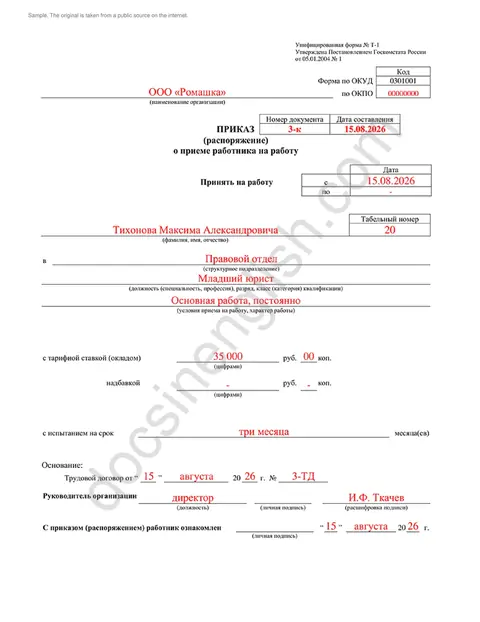
- a hiring order on form T-1: the form name and codes, the order number and date, the personnel number, the department, the position, the terms of hire, the salary, the probationary period and the basis (the employment contract with its number and date);
- an employment record book: every entry with its date, the job details and the basis (the order number and date), with seals and signatures;
- an employment letter or a certificate of employment: the company letterhead, the full text, the writer’s title and signature, the seal;
- an employment contract: every clause and the details of both parties.
Forms, job titles and amounts
We translate the captions under the lines of a form too, such as “(structural unit)” or “(position, profession)”, so it’s clear what each field holds. Blank fields and missing signatures are marked [blank].
We translate job titles and department names. Order and contract numbers and form codes stay as they are in the document, and “ООО” becomes LLC.
The salary and other amounts stay in rubles and kopecks, as in the document: we don’t convert them to dollars.
The translation has only what the document says. If the document doesn’t describe your duties, we don’t add a description: that comes from the employer in a letter, and we translate the letter.
Names and handwriting
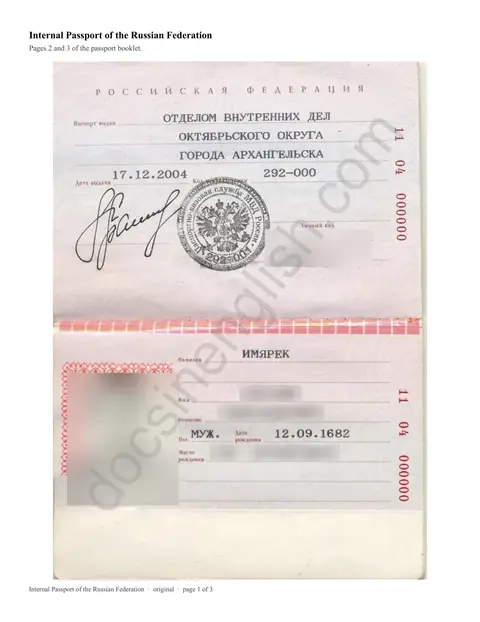
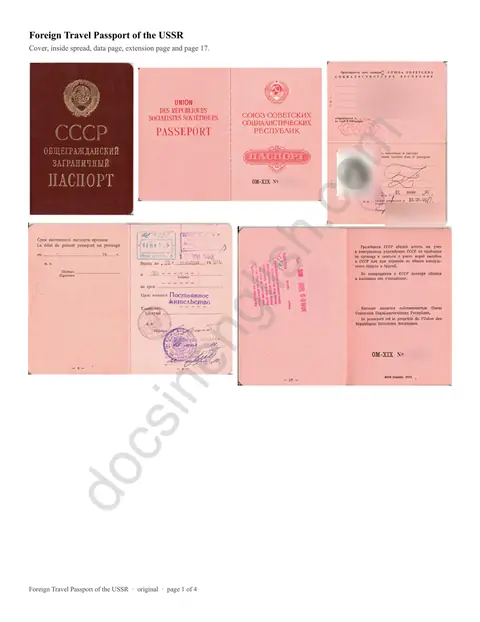
We spell names as they appear in your international passport. Include the spelling in your request, and we’ll use it in every document in your order.
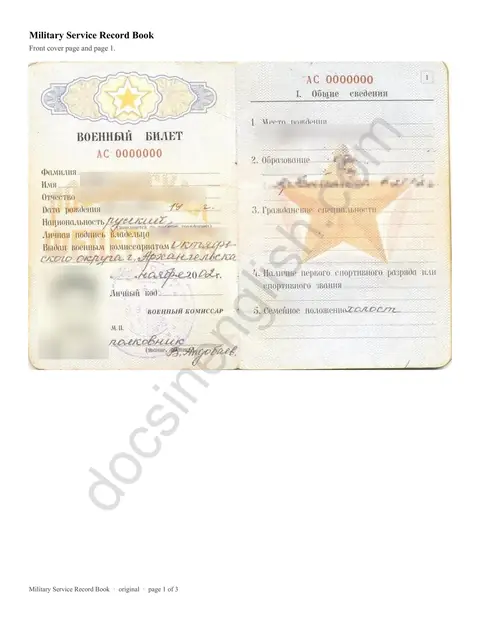
Entries in employment record books are often handwritten; that’s routine for us. If a word can’t be read, the translation marks it [illegible] instead of guessing.
Employment documents for EB-1A and O-1
For an EB-1A green card, and for an O-1 in science, education, business or athletics, two of the criteria in the rules are about your work:
- a leading or critical role for organizations with a distinguished reputation (8 CFR 204.5(h)(3)(viii) (opens in a new tab)); for an O-1, work in a critical or essential capacity for such organizations (8 CFR 214.2(o)(3)(iii)(B)(7) (opens in a new tab)). For EB-1A, the USCIS Policy Manual notes that letters from people who know your role firsthand can be particularly helpful here, as long as they explain in detail how the role was leading or critical (USCIS Policy Manual (opens in a new tab));
- a high salary or other significantly high remuneration for services compared with others in your field (8 CFR 204.5(h)(3)(ix) (opens in a new tab)); for an O-1, a high salary or other remuneration that you have commanded or will command, shown by contracts or other reliable evidence (8 CFR 214.2(o)(3)(iii)(B)(8) (opens in a new tab)). For EB-1A, the possible evidence listed in the Policy Manual includes tax returns, pay statements, a contract or job offer letter, and wage data for your field (USCIS Policy Manual (opens in a new tab)).
We translate employer letters, income certificates, employment contracts and orders in full, and amounts stay in rubles, as in the document. Articles about you for the same programs: publication translation; awards: award certificate translation.
Whether a criterion fits your case is for you or your attorney to decide; we translate what you send.
Where the translation goes
- USCIS: a full translation and the translator’s signed certificate. For an employment-based green card, letters from employers are the proof of experience; ordinary legible copies are generally fine for filing, but USCIS may ask for originals (8 CFR 204.5(g)(1) (opens in a new tab)). What USCIS accepts
What to file in your case is for you or your attorney to decide.
Sample translations
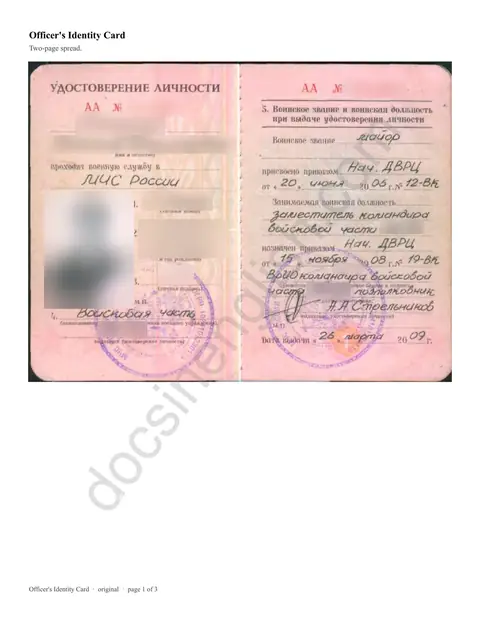
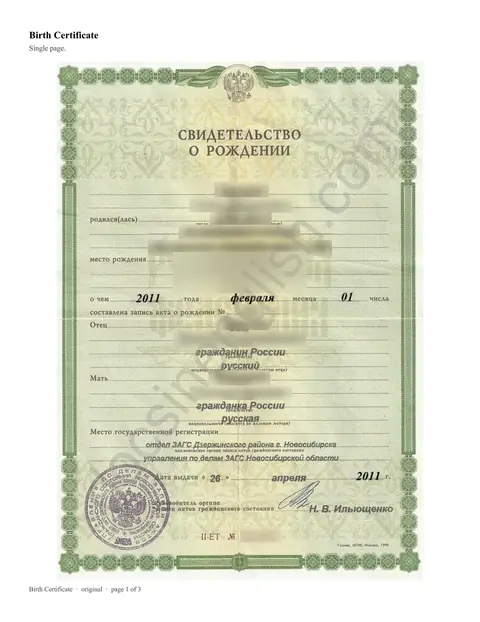
6 samplesEach sample has the original, the translation and the signed certificate. Personal details are blurred.
Questions
How much does it cost?
We charge by the page: $25 for the first page and $20 for each additional one. An employment record book is priced by the pages with entries. Send photos, and we’ll give you the exact price.
Will you convert the salary to dollars?
No. We give amounts as they appear in the document: in rubles and kopecks.
Do I need a notary?
USCIS rules don’t require one: they ask for the translator’s signed certificate, and it’s included.
How long does it take?
1–4 documents: within 24 hours after payment; faster, within 12 hours (+$15 a page) or 3 hours (+$30 a page, paid between 8 am and 6 pm Pacific time). For 5 or more, we give you the date with the quote.
Will USCIS accept the translation?
No one can promise that an agency will accept a document. We follow its rules to the letter, and if an agency raises an issue with our translation, we fix it for free.
How we do it
- Full translation
every stamp, signature and handwritten line
- Signed certificate
with the translator’s name, address and phone
- A PDF, ready to file
original, translation and certificate, translation pages numbered
- Price
$25 for the first page up to 250 words, $20 for each additional page, in the same document or another one.
- Turnaround
1–4 documents: within 24 hours after payment; faster, within 12 hours (+$15 a page) or 3 hours (+$30 a page, paid between 8 am and 6 pm Pacific time). For 5 or more, we give you the date with the quote.
This is a summary of what the agency publishes, not legal advice.