How do you translate a police certificate from Honduras for a US immigrant visa?
For an immigrant visa, the US Embassy in Tegucigalpa asks every applicant aged 18 or older for a police certificate from Honduras issued by the Dirección Policial de Investigaciones (DPI): the constancia de antecedentes policiales. USCIS and the immigration court ask for a full English translation with the translator’s signed certification. We translate the constancia in full, the electronic PDF or the paper copy, with seals, signatures and codes. It is usually one page: $25, ready within 24 hours after payment.
The constancia de antecedentes policiales
The US Embassy in Tegucigalpa asks every immigrant visa applicant aged 18 or older for the original police certificate issued by the DPI in Tegucigalpa: one showing the record if there is one, or one confirming that there is none. Police certificates are valid for two years and must still be valid at the interview (U.S. Embassy Tegucigalpa (opens in a new tab)).
The document is the constancia de antecedentes policiales. It costs 200 lempiras (about $10) and comes in an electronic and a paper version. Records from before 1995 may be missing, and there is no certificate for anyone under 18, because the database doesn’t hold records of children (U.S. Department of State (opens in a new tab)).
How to request it
In Honduras, you pay the 200-lempira fee with a TGR-1 form generated on the Finance Ministry’s website, bring a copy of your ID and the paid form to the DPI, and give your email or phone number; the constancia is sent to you as a PDF (Policía Nacional de Honduras (opens in a new tab)). The police also run a page to check a constancia (verificacion.policianacional.gob.hn (opens in a new tab)).
If you live outside Honduras, a lawyer or a close family member can apply for you with a copy of your ID, a letter of authorization and the letter of request. It usually takes less than a week (travel.state.gov (opens in a new tab)).
Antecedentes penales from the courts
The court record is a separate document. The State Department calls it antecedentes judiciales: the criminal courts issue it on Supreme Court paper, it shows only convictions, and the consular officer asks for it at the interview only if needed (travel.state.gov (opens in a new tab)). The Government of Canada lists a court certificate, the constancia de antecedentes penales, issued by the Poder Judicial (Government of Canada (opens in a new tab)). An applicant convicted of a crime brings the court disposition and police records (U.S. Embassy Tegucigalpa (opens in a new tab)).
What the translation includes
The translation is complete, as USCIS requires (8 CFR 103.2(b)(3) (opens in a new tab)): the Security Ministry and DPI heading, the text of the certificate with your name and ID number, the result, the dates, the signature and seal in square brackets, and any code for checking it. Names follow your passport; tell us the spelling when you order.
Where the translation goes
- NVC and US consulates: the Department of State doesn’t ask for a translation of a certificate in Spanish if you are applying for your visa in Honduras or another country where Spanish is an official language. What NVC accepts
- USCIS: the Form I-485 instructions ask for certified police and court records of any criminal charges, arrests or convictions, including outside the United States (Form I-485 instructions (opens in a new tab)). What USCIS accepts
- Immigration court: a typed certification with the translator’s address and phone. What the court accepts
Our Spanish documents are translated and certified by a native Spanish speaker. What to file in your case is for you or your attorney to decide.
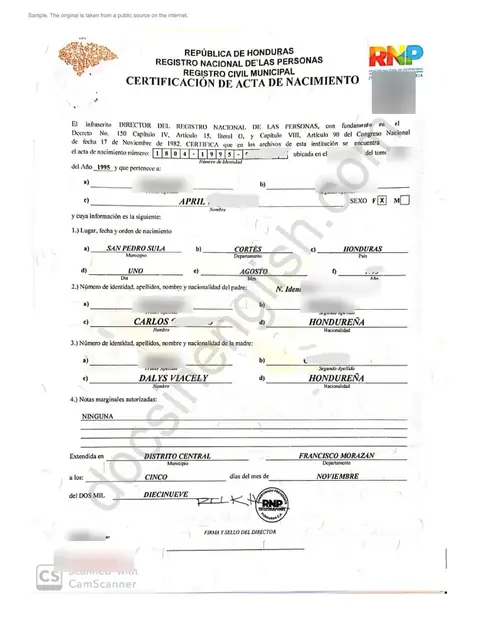
Sample translation
The sample has the original, the translation and the signed certificate. Personal details are blurred.
Questions
The DPI sent my constancia as a PDF. Can you translate it?
Yes. Send us the PDF exactly as it arrived, and we translate it from that file.
How much does it cost?
A constancia is usually one page: $25. Each additional page in the same order is $20, so a constancia de antecedentes policiales, a court record and one more page are $65.
Do I need a notary or an apostille?
No notary: USCIS and the immigration court ask for the translator’s signed certification, which we include. If your constancia carries an apostille, we translate it in the same order.
How long does it take?
1–4 documents: within 24 hours after payment; faster, within 12 hours (+$15 a page) or 3 hours (+$30 a page, paid between 8 am and 6 pm Pacific time). For 5 or more, we give you the date with the quote.
How we do it
- Full translation
every stamp, signature and handwritten line
- Signed certificate
with the translator’s name, address and phone
- A PDF, ready to file
original, translation and certificate, translation pages numbered
- Price
$25 for the first page up to 250 words, $20 for each additional page, in the same document or another one.
- Turnaround
1–4 documents: within 24 hours after payment; faster, within 12 hours (+$15 a page) or 3 hours (+$30 a page, paid between 8 am and 6 pm Pacific time). For 5 or more, we give you the date with the quote.
This is a summary of what the agency publishes, not legal advice.