How do you translate a police certificate from Spain for a US immigrant visa?
For a US immigrant visa, Spain’s police certificate is the certificado de antecedentes penales, issued by the Central Registry of Convicts on behalf of the Ministry of Justice. You can request it online, from outside Spain too. We translate it in full: your name and document number, whether any records exist, the electronic signature and the validation code. A certificate is usually one page: $25, ready within 24 hours after payment.
What the certificate is
The certificado de antecedentes penales shows whether the Central Registry of Convicts (Registro Central de Penados) holds any criminal records for you on the date it is issued (Ministerio de Justicia (opens in a new tab)). It is a page with your name and passport or DNI number that states whether there are records. Some carry a stamp, but almost all now have an electronic signature you can validate online with the code on the certificate (U.S. Department of State (opens in a new tab)).
What the Department of State says for Spain
The reciprocity page for Spain sets out (U.S. Department of State (opens in a new tab)):
- who can request it: anyone 18 or older with a valid passport from any country, a Spanish identity card or a Spanish residence permit; under 18, it isn’t required;
- from abroad: you can get it online without being in Spain, even if you no longer live there, and a former resident can apply with an expired NIE;
- apostille: not required;
- court records: anyone ever convicted in Spain should provide them as well.
An online certificate is usually ready in 24 hours; some take longer, generally no more than 3 business days. For a national of another EU country, the registry also collects records from that country, and it can take up to 30 days (Sede Electrónica, Ministry of Justice (opens in a new tab)).
Who needs a police certificate
For an immigrant visa, NVC asks anyone 16 or older for a certificate from their country of nationality and their current country of residence after more than six months there, from any country where they lived for 12 months or more from age 16, and from any place where they were arrested. A police certificate expires after two years, unless it comes from a country of previous residence you haven’t returned to since (civil documents (opens in a new tab)).
What the translation includes
We translate the whole certificate (8 CFR 103.2(b)(3) (opens in a new tab)): the heading, your name and document number, the statement of whether records exist, the date of issue, the electronic signature details and the validation code. When you request it for use abroad, the Ministry offers an apostille option (Sede Electrónica (opens in a new tab)); if your copy has one, the translation covers it. Your name follows your passport.
Where the translation goes
- NVC and US consulates: the Department of State doesn’t ask for a translation of a certificate in Spanish if you are applying for your visa in Spain or another country where Spanish is an official language. What NVC accepts
- USCIS: for a green card, the Form I-485 instructions ask for certified police and court records of any criminal charges, arrests or convictions, including outside the United States (Form I-485 instructions (opens in a new tab)). What USCIS accepts
- Immigration court: a typed certification with the translator’s address and phone. What the court accepts
Our Spanish documents are translated and certified by a native Spanish speaker. What to file in your case is for you or your attorney to decide.
Sample translations
3 samplesEach sample has the original, the translation and the signed certificate. Personal details are blurred.
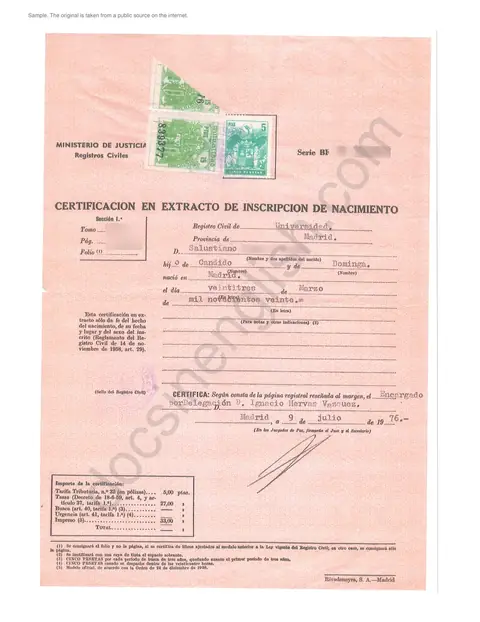
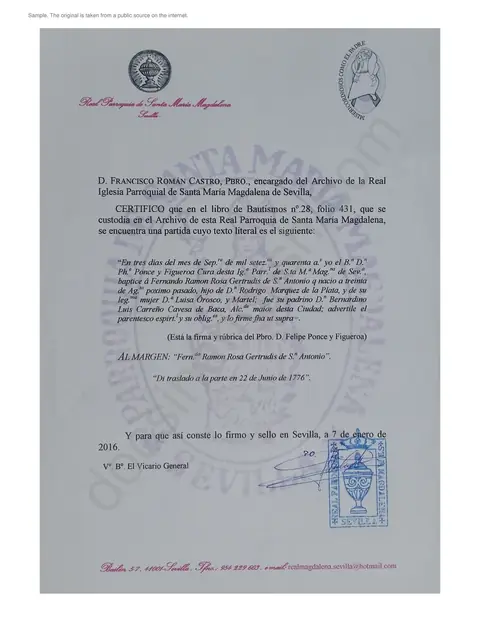
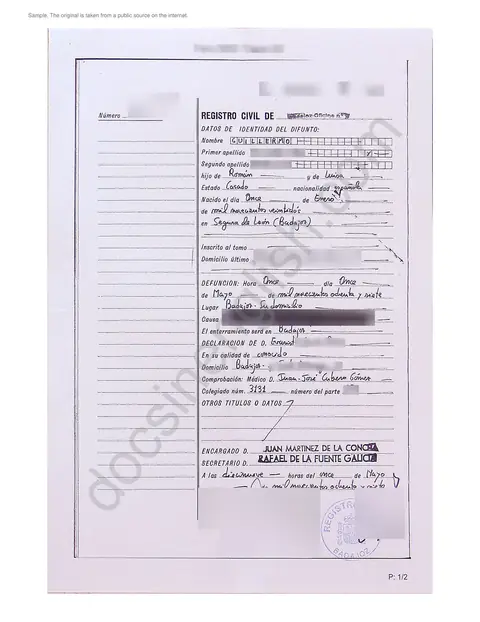
Questions
Do I also need the certificado de antecedentes policiales?
The Department of State says that certificate, which lists police encounters, is generally not required for consular purposes. If you have one, we translate it the same way.
How much does it cost?
A certificate is usually one page: $25. Each additional page in the same order is $20, so a certificate with an apostille page and one court record page is $65.
Do I need a notary or an apostille?
Not for the visa: the Department of State says Spain’s police certificate doesn’t need an apostille, and NVC asks for the translator’s signed certification, which is included. If you chose the apostille option, we translate it too.
How long does it take?
1–4 documents: within 24 hours after payment; faster, within 12 hours (+$15 a page) or 3 hours (+$30 a page, paid between 8 am and 6 pm Pacific time). For 5 or more, we give you the date with the quote.
How we do it
- Full translation
every stamp, signature and handwritten line
- Signed certificate
with the translator’s name, address and phone
- A PDF, ready to file
original, translation and certificate, translation pages numbered
- Price
$25 for the first page up to 250 words, $20 for each additional page, in the same document or another one.
- Turnaround
1–4 documents: within 24 hours after payment; faster, within 12 hours (+$15 a page) or 3 hours (+$30 a page, paid between 8 am and 6 pm Pacific time). For 5 or more, we give you the date with the quote.
This is a summary of what the agency publishes, not legal advice.