How do you translate a Dominican divorce certificate (acta de divorcio) for USCIS?
If you or your spouse were married before, USCIS asks for proof that each earlier marriage legally ended, translated in full into English with the translator’s signed certification. For a Dominican divorce, the civil registry office (Oficialía del Estado Civil) issues the acta de divorcio once the family court judgment (sentencia) is final. We make a certified translation of the Dominican divorce certificate and the judgment, seals and notes included. A one-page acta is $25, ready within 24 hours after payment.
How a Dominican divorce is recorded
A Dominican divorce passes through a court and then the civil registry (U.S. Department of State (opens in a new tab)):
- A spouse files the petition with the family court for the place where that spouse lives, and the judge rules on it.
- Once the ruling is final, it is registered and published, and the civil registry office (Oficialía del Estado Civil) pronounces the divorce.
- The acta de divorcio is then issued by the Oficialía where the decree was registered, or by any service center of the Central Civil Registry Office.
A divorce can leave three papers: the judgment, the acta de divorcio and the marriage record with a divorce entry. A German court’s checklist for recognizing Dominican divorces asks for all three (Oberlandesgericht Dresden (opens in a new tab)). We translate any of them.
Inextensa, extracto and the 2025 format
Until July 1, 2025, Dominican civil records came either as a short extract or as a full copy (inextensa). Since that date, certificates of birth, recognition, marriage, divorce and death share one format without those labels. For immigrant and K visas, the embassy in Santo Domingo still asks for the acta inextensa if your copy predates July 1, 2025, and accepts copies in the new format issued after it. Legalization of Dominican civil documents isn’t required for visa purposes (U.S. Department of State (opens in a new tab)).
What we translate
We translate the acta in full, as USCIS requires (8 CFR 103.2(b)(3) (opens in a new tab)): each line and number in the order of the original, the officer’s signature and seal, and every stamp on your copy. A judgment is translated page by page, with the court’s seals. A word that can’t be read is marked [illegible], never guessed.
Dominican records list two surnames. We keep them in the order of the acta and spell names as in your passport. Every document in your order uses the same spelling.
Where the translation goes
- USCIS: for Form I-130, documents showing that each prior marriage was legally terminated, with a full English translation and the translator’s signed certification (Form I-130 instructions (opens in a new tab)). What USCIS accepts
- NVC and US consulates: the Department of State asks for evidence that every prior marriage ended, such as the final divorce decree (civil documents (opens in a new tab)). It doesn’t ask for a translation of a certificate in Spanish if you are applying for your visa in the Dominican Republic or another country where Spanish is an official language. What NVC accepts
- Immigration court: a typed certification with the translator’s address and phone. What the court accepts
Our Spanish documents are translated and certified by a native Spanish speaker. What to file in your case is for you or your attorney to decide.
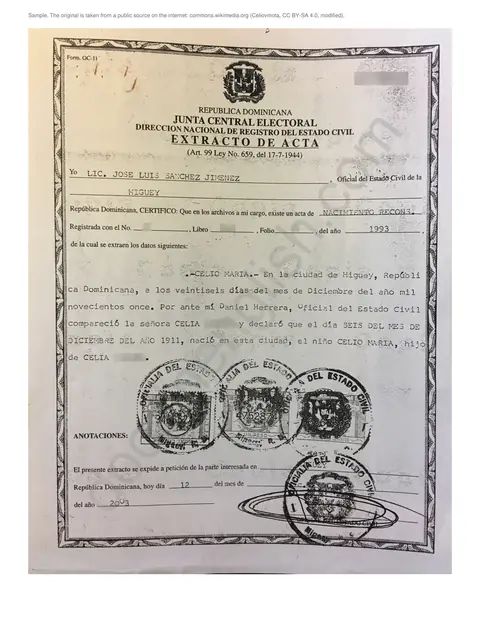
Sample translation
The sample has the original, the translation and the signed certificate. Personal details are blurred.
Questions
My acta was issued after July 2025 and doesn’t say “inextensa”. Can you still translate it?
Yes, the single format is translated the same way. For immigrant and K visas, the Department of State says the embassy in Santo Domingo accepts civil documents issued after July 1, 2025 without the inextensa or extracto label.
How much does it cost?
A one-page acta is $25. Each additional page in the same order is $20, so an acta and a two-page judgment are $65.
Do I need a notary or an apostille?
Not for USCIS: it asks for the translator’s signed certification, and it’s included. For a visa, the Department of State says Dominican civil documents don’t need legalization.
How long does it take?
1–4 documents: within 24 hours after payment; faster, within 12 hours (+$15 a page) or 3 hours (+$30 a page, paid between 8 am and 6 pm Pacific time). For 5 or more, we give you the date with the quote.
How we do it
- Full translation
every stamp, signature and handwritten line
- Signed certificate
with the translator’s name, address and phone
- A PDF, ready to file
original, translation and certificate, translation pages numbered
- Price
$25 for the first page up to 250 words, $20 for each additional page, in the same document or another one.
- Turnaround
1–4 documents: within 24 hours after payment; faster, within 12 hours (+$15 a page) or 3 hours (+$30 a page, paid between 8 am and 6 pm Pacific time). For 5 or more, we give you the date with the quote.
This is a summary of what the agency publishes, not legal advice.