How do you translate a Peruvian police certificate: antecedentes policiales, penales and judiciales?
Peru has three certificates where other countries have one police certificate: antecedentes policiales from the National Police, antecedentes penales from the Judiciary and antecedentes judiciales from the prison institute INPE. For an immigrant visa, the US Embassy in Lima asks for the Certificado Único Laboral, which combines all three. We translate each one in full: the heading, your name and DNI, the result, the stamps, the signature and any QR code. A certificate is usually one page: $25, ready within 24 hours after payment.
Three certificates, three offices
The State Department page for Peru lists each record separately (U.S. Department of State (opens in a new tab)):
- Certificado de Antecedentes Policiales, the police record, from the Policía Nacional del Perú at local police stations. Green paper, the heading “Policia Nacional del Peru, División de Identificación”, a scanned photo, signed by a police commander. A clean record reads “No Registra Antecedentes”.
- Certificado Judicial de Antecedentes Penales, the court record, from the Registro Nacional de Condenas of the Judiciary. Blue and orange paper, the heading “Poder Judicial”, a hologram, a thermochromic ink stamp and the scanned signature of the head of the registry. It shows whether a person was convicted of a crime.
- Certificado de Antecedentes Judiciales a Nivel Nacional, the prison record, from the Instituto Nacional Penitenciario (INPE). Green paper, the INPE shield and a photo; it lists entries, exits and convictions of anyone held in a Peruvian prison. The online version has a QR code at the bottom.
All three are for people 18 and older. A fourth, from the Fuero Militar Policial, covers offenses of career service members on duty; people who never served don’t need it for an immigrant visa at the US Embassy in Lima. The embassy makes no distinction between police certificates issued for local and for international use.
The single certificate the embassy asks for
For immigrant visa processing, the US Embassy in Lima asks for the Certificado Único Laboral (CUL), which combines the police, court and prison records in one document (U.S. Department of State (opens in a new tab)):
- it is issued online and free of charge by the Ministry of Labor (Ministerio de Trabajo y Promoción de Empleo), to people 18 and older;
- it is printed on white paper with the ministry’s emblem, a digital signature and a QR code next to your details;
- a clean record reads “No Registra Antecedentes” under each of the three headings: Antecedentes Policiales, Antecedentes Judiciales and Antecedentes Penales;
- if any section shows an error, you submit the separate certificate for that section.
The State Department asks you to scan the QR code and check the certificate before you submit it. We translate the CUL in full, with all three sections and a note for the QR code.
Getting them from outside Peru
- The court record is also issued by Peruvian consulates worldwide (U.S. Department of State (opens in a new tab)), and online as a digitally signed PDF with the same validity as the paper one (gob.pe (opens in a new tab)).
- For the court and prison records, a representative in Peru can apply for you with a power of attorney signed at a Peruvian consulate and apostilled by Peru’s Ministry of Foreign Affairs (U.S. Department of State (opens in a new tab)).
- A non-resident can get a police record from the División de Identificación Criminalística in Lima after first requesting a fingerprint chart (ficha de canje internacional) (U.S. Department of State (opens in a new tab)).
Names
The police check your mother’s surname: a woman whose DNI shows her married surname instead of it is asked to bring her birth or marriage certificate when she applies (gob.pe (opens in a new tab)). In the translation we keep the surnames in the order the certificate prints them and use the spelling of your passport.
Where the translation goes
- NVC and US consulates: for an immigrant visa, the US Embassy in Lima asks for the Certificado Único Laboral. The Department of State doesn’t ask for a translation of a certificate in Spanish if you are applying for your visa in Peru or another country where Spanish is an official language (civil documents (opens in a new tab)). What NVC accepts
- USCIS: for a green card, the Form I-485 instructions ask for certified police and court records of any arrests, charges or convictions (Form I-485 instructions (opens in a new tab)). What USCIS accepts
- Immigration court: a typed certification with the translator’s address and phone. What the court accepts
Our Spanish documents are translated and certified by a native Spanish speaker. What to file in your case is for you or your attorney to decide.
Sample translations
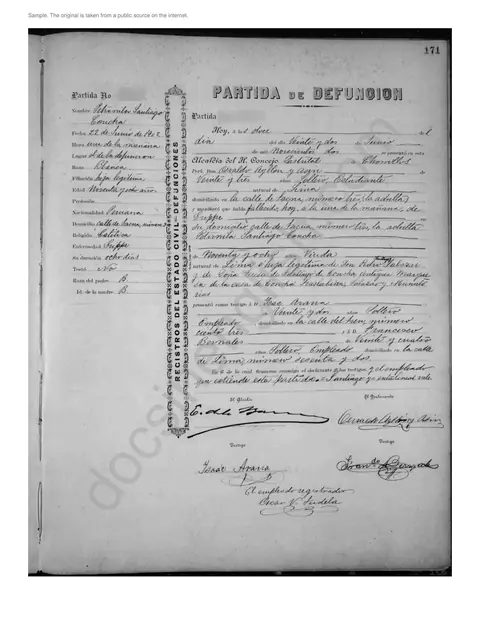
2 samplesEach sample has the original, the translation and the signed certificate. Personal details are blurred.
Questions
I have all three certificates. Is that one order?
Yes. We translate them in one order, with one spelling of your name in all three.
Do you translate the electronic PDF from the Poder Judicial?
Yes, with the details of its digital signature, the same way as a paper certificate.
How much does it cost?
A certificate is usually one page: $25. Each additional page in the same order is $20, so the three certificates are $65.
Do I need a notary or an apostille?
Not for USCIS or NVC: they ask for the translator’s signed certification, and it’s included. If a certificate carries an apostille, we translate it too.
How long does it take?
1–4 documents: within 24 hours after payment; faster, within 12 hours (+$15 a page) or 3 hours (+$30 a page, paid between 8 am and 6 pm Pacific time). For 5 or more, we give you the date with the quote.
How we do it
- Full translation
every stamp, signature and handwritten line
- Signed certificate
with the translator’s name, address and phone
- A PDF, ready to file
original, translation and certificate, translation pages numbered
- Price
$25 for the first page up to 250 words, $20 for each additional page, in the same document or another one.
- Turnaround
1–4 documents: within 24 hours after payment; faster, within 12 hours (+$15 a page) or 3 hours (+$30 a page, paid between 8 am and 6 pm Pacific time). For 5 or more, we give you the date with the quote.
This is a summary of what the agency publishes, not legal advice.